
Fire Pit vs. Outdoor Fireplace: Which Fits Your Northeast Ohio Backyard?
A fire pit gathers people in a circle while an outdoor fireplace anchors one side of a patio, and space, fuel and Ohio’s fire rules help decide which fits.
A fire pit and an outdoor fireplace both give a backyard a place to gather around a fire, but they work in different ways. A built fire pit is an open fire set low in a ring of stone or block that people sit around on every side. An outdoor fireplace, as this guide uses the term, is a built masonry structure with a firebox and a chimney, and people face it from the front the way they would an indoor hearth. Neither one is the better choice in every yard. Which fits depends on how you like to gather, where the feature can go on your property and what you want it to burn.
This guide is for homeowners in Northeast Ohio deciding between a fire pit and an outdoor fireplace. It covers how each one is used, where each can go under Ohio’s fire rules, whether to burn wood or gas and what building each one involves. Where it cites a rule, it names the source, and because local fire departments enforce those rules and communities can add their own, it points you to them for what applies on your street. Cost isn’t covered here, since it depends on the size, the site and the design. The guide closes with how to choose.

Is a Fire Pit or an Outdoor Fireplace Better for Your Backyard?
Neither is better across the board; each suits a different way of spending an evening outside. A fire pit suits a circle of people, with chairs or a built-in bench on all sides and conversation moving across the fire. An outdoor fireplace suits a defined outdoor room, where seating faces the fire from one side much as it would indoors. That difference in how people gather is the first thing to settle, because it shapes the layout of everything around the feature.
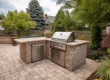
The two also take up space differently. A fire pit is low, so it keeps sightlines open across the patio and out to the yard, and it can sit in the middle of a seating area or on its own pad farther out. An outdoor fireplace is tall and solid, and that height lets it do things a fire pit can’t: it can screen a neighbor’s view, block wind from one direction and give a patio a clear focal wall. It can also anchor a seating or dining area next to an outdoor kitchen, and our guide to planning an outdoor kitchen in Northeast Ohio covers how to plan that kitchen area from the ground up.
Smoke behaves differently, too. A fireplace’s chimney gives smoke a path up and away from the seating in front of it, while a fire pit’s smoke goes wherever the wind takes it, so on a shifting breeze someone in the circle may end up moving a chair. Neither design makes a fire smoke-free, and the wood you burn matters as much as the structure, which the section on fuel covers below. At Hemlock Landscapes, our team guides homeowners in selecting a fire pit or outdoor fireplace and integrating it with the patio and the rest of the landscape design.
Which Gives Off More Heat, a Fire Pit or an Outdoor Fireplace?
They spread heat differently rather than one simply running warmer. A fire pit radiates warmth in every direction, so everyone in the circle gets some of it, though your back stays cool. An outdoor fireplace’s firebox directs heat forward toward the seating in front of it, which suits a row of chairs facing the fire.

How Far Does a Fire Pit or Outdoor Fireplace Need to Be From the House?
Under the Ohio Fire Code, a wood fire in a built fire pit counts as a recreational fire, and a recreational fire has to be at least 25 feet from a structure or combustible material. A fire in a gas-fired recreational pit has to be at least 15 feet away. Those distances are the starting point for where a fire pit can go. Local fire departments enforce the code, and a city or village can add rules of its own, so the first step in placing a fire feature is checking what your community allows.
An outdoor fireplace falls into a different category. The code’s definition of a recreational fire covers fuel that isn’t contained in an outdoor fireplace, a portable outdoor fireplace, a grill or similar equipment, so the 25-foot distance is written for open fires like a fire pit rather than for a built fireplace with a chimney. What applies to a built outdoor fireplace on your property is a question for your local fire and building departments, and it’s worth asking before a design is final.
Ohio EPA’s open burning rule adds conditions of its own. Under Ohio Administrative Code 3745-19-03, campfires and outdoor fireplace equipment used for warmth, cooking or recreation are allowed even in restricted areas, which cover cities and villages and, for larger ones, a zone around them, when they meet the rule’s conditions. The fire has to burn clean seasoned firewood, natural gas or an equivalent, or another clean-burning fuel with emissions no higher than seasoned firewood’s, and it can’t be used for waste disposal. Its total fuel area can be no more than three feet across and two feet high, and the fire has to be no larger than its purpose requires, with fuel chosen to keep air contaminants to a minimum. Shaker Heights, for example, publishes the same 25-foot distance and size limit for recreational fires. It also requires that the fire be constantly attended until it’s out, with a fire extinguisher rated at least 4A, a water bucket or a garden hose on hand. The Ohio Fire Code also lets state and local officials declare temporary bans on recreational fires, so check for one before lighting a fire.
Distance shapes the design as well. On a smaller lot, keeping 25 feet from the house, the garage and a wood fence can rule out much of the yard. A fire pit set that far out needs a surface of its own and a way to reach it, and both belong in the plan from the start.
Can You Put a Fire Pit Under a Covered Patio?
A wood-burning fire pit under a patio roof wouldn’t meet the Ohio Fire Code’s 25-foot distance from a structure. A gas fire pit carries its own 15-foot distance under the code, along with the manufacturer’s installation instructions. If a covered patio is where you want a fire, ask your local fire department what it allows before planning one there.

Should a Fire Pit or Outdoor Fireplace Burn Wood or Gas?
Wood gives the crackle, smell and glow of a traditional fire, while gas lights without kindling, shuts off as soon as the gas is turned off and leaves no ash to clean out. Both are allowed under Ohio EPA’s open burning rule, which names clean seasoned firewood and natural gas among the acceptable fuels. The choice comes down to the experience you want, the upkeep you’re willing to take on and where the feature has to go.
A wood fire depends on dry wood. The U.S. Environmental Protection Agency’s Burn Wise guidance says wood burns best at a moisture content of less than 20% and recommends seasoning it for at least six months, stored outdoors and off the ground with only the top covered. The same guidance says not to burn wet or green wood. With a fire pit, there’s no chimney to carry smoke up and away, so the condition of the wood is the main thing within your control.
Gas changes where a fire pit can go. With the Ohio Fire Code’s 15-foot distance for gas-fired pits instead of 25 feet for wood, a gas fire pit can sit closer to the house, which can open up spots on a smaller lot. A natural-gas fire pit needs a supply line run to the feature, while some listed fire pits run on propane instead. Gas work may need a permit and a qualified installer, so check the fire pit’s instructions and your local building department before settling on a location.
The same choice applies to a masonry outdoor fireplace, which can be designed for wood or for a listed gas system. The fuel shapes how the firebox is built, so it’s decided early in the design rather than after. Some manufactured outdoor gas fireplaces are vent-free and need no chimney at all, and they follow their own installation and clearance instructions.

What Goes Into Building a Fire Pit or Outdoor Fireplace?
Both start with what’s underneath them. A built fire pit is a ring of block or stone set on a prepared base, with a metal insert where the kit calls for one; Belgard, for example, sells a metal insert for its Highland fire pit kit. A masonry outdoor fireplace is a much taller and heavier structure, and it needs a footing sized for its weight. In Northeast Ohio, both also have to be built for winters that freeze and thaw.
Water that freezes in the ground under a hardscape can lift it, and a base that settles unevenly can shift a fire pit ring or crack a fireplace. Our article on how freeze-thaw damage shows up in paver patios explains how water and frost move a patio, and a fire feature built on or beside that patio faces the same forces. How deep a footing has to go is set locally, so your building department, not a general rule of thumb, decides it.
A fire feature also has to fit the patio around it. The fire pit’s base, the patio surface and the seating around it are planned together, and an outdoor fireplace’s footing is planned with the patio rather than cut in later. A built outdoor fireplace or a new gas line may need a permit, so the design stage is also the time to find out what your municipality requires.
Hemlock Landscapes handles fire pit and outdoor fireplace installation as part of its hardscape work, from the design through the build. Our design/build process can include 3D renderings and scaled drawings before installation begins, so you can see the feature in place before anything is built.
As a Belgard Master Craftsman and Belgard Authorized Contractor, Hemlock installs Belgard patios and fire pits. Belgard’s Master Craftsman requirements include a five-year workmanship warranty, and its Authorized Contractor requirements include having 10 Belgard installations inspected and approved by a Belgard sales representative each year.
If you’d rather build a simple fire pit yourself, our step-by-step guide to building a backyard fire pit walks through the materials and the steps.
Can You Put a Fire Pit on a Paver or Concrete Patio?
Plan a built-in fire pit with the patio, so it gets a base suited to its system rather than being added to a finished surface without a check of its support and installation requirements. A freestanding fire pit follows its manufacturer’s instructions for the surface beneath it. Still choosing the patio? Our comparison of pavers and concrete covers how each surface is built and cared for.

How Do You Choose Between a Fire Pit and an Outdoor Fireplace?
Start with how you want to use the space, because the other decisions follow from it. If you picture a circle of chairs and conversation moving around the fire, a fire pit fits; if you picture an outdoor room with seating facing a hearth, perhaps beside a dining or kitchen area, a fireplace fits. Some yards have room for both, with a fireplace anchoring the patio and a fire pit farther out.
Next, settle where the feature can go. For a fire pit, measure the distances the Ohio Fire Code sets from your house, garage, fences and other combustible material, then ask your local fire department whether your community adds anything. Then choose the fuel, keeping in mind that natural gas needs a supply line, propane systems follow their listed installation requirements and wood needs a supply of seasoned firewood and a place to store it.
Last, look at how the feature fits the patio and the rest of the yard. A fire pit or fireplace planned with the patio gets a proper base, a surface that suits it and a layout that works for seating, while one added later has to fit around what’s already there. That’s why the landscape design process starts with how you’ll use the space and produces a scaled plan before installation begins.
To talk through a fire pit or outdoor fireplace for your yard, contact Hemlock Landscapes.