
Pavers vs. Concrete: Which Patio Is Right for a Northeast Ohio Yard?
Both patio surfaces can work in Northeast Ohio when they’re built on the right base, but they move, wear and get repaired differently.
A paver patio and a poured concrete patio can both give a Northeast Ohio yard a durable place to sit, cook and gather. They’re built differently, though, and the difference shows over the years. Pavers are separate units that can shift and be reset, while a concrete slab is one continuous piece with joints that steer where it cracks. Each also asks for different care through the winter. The right choice depends on how you’ll use the space, the look you want and how each surface behaves on your site.
This guide is for homeowners in Northeast Ohio deciding between the two. It explains how each patio is built, how each handles freeze-thaw winters, which one is easier to repair, what upkeep each needs and how each fits a design. Where it describes how a material behaves, it names the source, which for each material is mainly that material’s own industry association. Cost isn’t covered here, since it depends on the size, the site and the design. The guide closes with how to choose.

What Is the Difference Between a Paver Patio and a Concrete Patio?
A common paver patio system sets the units on bedding sand over a compacted aggregate base, and that’s the system this guide compares. Sand fills the joints between the units, and an edge restraint around the outside holds the field in place. A concrete patio is a single slab poured over a prepared base. Joints are cut or tooled into the slab to steer cracking along those planned lines.
In that system, each part has a job. The base carries the load, the joint sand helps lock the units together and the edge keeps them from spreading. The Concrete Masonry & Hardscapes Association (CMHA), the industry association for concrete masonry and hardscape products, notes in its maintenance guide that pavers “can act as a zipper in the pavement,” since units can be taken up for work underneath and put back. The industry’s product standard for interlocking concrete pavers is ASTM C936.
Poured concrete makes a different kind of surface. It can be given a broom finish or exposed aggregate, and it can be colored, stained, scored or stamped. At Hemlock Landscapes we install both paver and concrete patios, using patio pavers in a range of shapes, sizes and colors and designing concrete patios for both appearance and longevity.
What Is Stamped Concrete?
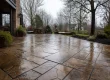
Stamped concrete is poured concrete pressed with patterned mats while it’s still workable, often with added color, so the surface resembles pavers, brick or stone. It looks like separate pieces, but it’s still one slab. It has control joints like any slab, and it cracks and is repaired the way a slab is, not the way pavers are.

How Do Pavers and Concrete Handle Northeast Ohio’s Freeze-Thaw Winters?
Both can come through a Northeast Ohio winter in good shape, and both can be damaged when water gets under or into them and freezes. The difference is in how the damage shows. A paver patio tends to shift or settle in spots, while a concrete slab tends to crack or lose its surface. How much of either happens depends as much on what’s underneath as on the surface itself.
On the paver side, CMHA says pavers are “less likely to crack during freeze-thaw cycles, as the small joints between pavers accommodate natural expansion and contraction.” The trade-off is movement. CMHA’s maintenance guide traces depressions in a paver surface to “settlement of the underlying subgrade or granular base, often from inadequate compaction.” The same joints that let a paver patio flex also let a weak base show up as low spots and uneven units.
Concrete handles the cold differently. The National Ready Mixed Concrete Association (NRMCA), the industry association for ready-mixed concrete producers, describes scaling as “local flaking or peeling of a finished surface of hardened concrete as a result of exposure to cycles of freezing and thawing.” Part of the defense is built into the mix. Air-entrained concrete, NRMCA explains, “contains millions of small air bubbles that accommodate the expanding water and ice.” NRMCA adds that deicing chemicals make scaling worse by raising the saturation of the surface and the number of freeze-thaw cycles it goes through.
Under either surface, frost works on water. Soil that holds water, as clay does, gives freezing ground more to push against, and water left standing on a patio finds its way into joints and pores. That’s why the base and the way water leaves the patio are part of the plan for either material.
Why Do Concrete Patios Crack?
NRMCA explains that concrete tends to shrink and is weak in tension, so a slab that’s restrained from shrinking can crack. Cracks “cannot be prevented entirely,” it says, “but they can be controlled and minimized by properly designed joints.” Contraction joints create weakened planes in the slab so that cracks are more likely to form there than at random. NRMCA recommends a maximum joint spacing of 24 to 36 times the slab’s thickness and no more than 15 feet. For a 4-inch slab, it puts the spacing at about 10 feet. It also notes that irregular cracks, while unsightly, generally don’t affect the concrete’s integrity.

Which Patio Is Easier to Repair?
Pavers are the easier surface to repair in a way that blends in. A section can be lifted, the base beneath it corrected and the same units set back in place. A concrete slab can have its cracks sealed or a damaged section cut out and replaced, but new concrete beside weathered concrete can differ in color and texture. Matching a stamped pattern or an added color makes that harder.
CMHA’s maintenance guide lays out the paver repair in a short sequence: “Replace with new pavers, compact, refill joint sand, compact.” The same approach serves work below the surface. When a utility line needs attention or a walkway is added later, units can be taken up and put back rather than cut out. With a slab, that kind of work means cutting the concrete and pouring new concrete to fill the gap.
Either surface can reach a point where surface repairs aren’t enough. When the base has settled or heaved across a wide area, resetting pavers or patching a slab only treats the symptom, and the base in that area needs rebuilding. Our article on freeze-thaw damage explains when a paver patio needs repair and when it may need partial rebuilding. For a slab, the same question comes down to whether the cracks are isolated or the slab has moved as a whole.
Can You Replace a Single Paver?
Yes. CMHA says that “if a paver becomes damaged, it can be replaced individually without disturbing the surrounding ones.” Its maintenance guide also recommends storing a small stockpile of spare pavers from every project for repairs. Even a stored spare can look different from pavers that have weathered in place, so the guide suggests scattering replacements through the pattern to reduce the visual impact of color differences.

What Upkeep Does Each Patio Need Through the Year?
A paver patio needs its joint sand kept full and any settled spots reset. A concrete patio needs its joints and cracks watched, and stamped concrete needs resealing from time to time. Both need water to run off and away, and both need some care in winter with snow tools and deicers. Neither one is free of upkeep, but the tasks differ.
For pavers, CMHA’s maintenance guide gives a simple test for the joints: if the joint sand has dropped more than half an inch, top it up. Full joints help the units stay locked together. For winter, the guide says experience shows “easier snow removal by shoveling and plowing in a direction diagonal to the joints to prevent catching the edge.” Settled spots are fixed the same way as a repair, by lifting the units, correcting what’s beneath them and setting them back.
For concrete, NRMCA’s advice on deicers starts with new slabs: “Avoid using deicing chemicals on newly placed concrete, if possible. Use clean sand for traction.” After that, deicers can still add to scaling, and their ingredients matter. NRMCA says never to use ammonium sulfate, ammonium nitrate or magnesium-based salts as a deicer, calling them chemically aggressive to concrete surfaces. The Tennessee Concrete Association says deicers containing magnesium or acetate should be avoided, too. Stamped concrete also relies on a sealer to protect its decorative surface, and Concrete Network, a concrete industry information site, puts its resealing interval at two to five years, depending on traffic, climate and the previous sealer.
Fall is a good time to look over either surface. Clearing leaves and debris keeps moisture from sitting on the patio, and small gaps or cracks are easier to deal with before the hard freezes. Our fall hardscape maintenance guide covers cleaning, inspection and sealing in more detail.
Can You Use Ice Melt on a New Concrete Patio?
NRMCA and the Tennessee Concrete Association both urge caution. NRMCA recommends avoiding deicing chemicals on newly placed concrete when possible and using clean sand for traction. The Tennessee group is more specific: new concrete should be at least three months old before deicers containing sodium chloride or calcium chloride are used, and deicing salts aren’t recommended in its first winter. For a patio poured late in the season, plain sand is the safer choice until spring.

Which Patio Fits Your Design?
That depends on the look you want and the shape of the space. Pavers bring pattern, color variation, borders and curves, all built from individual units. Concrete gives a continuous, clean surface that can be colored, stamped or textured, and it suits simple shapes and a modern look. In a landscape design project, the patio material is chosen alongside the house, the plantings and the other hardscape so the pieces read as one plan.
Matching matters as much as the patio itself. A paver patio can share units or a border with a walkway or steps, and a concrete patio can echo a poured walk. We aim to build walkways that match the overall hardscape design, and the same thinking applies to a patio. Color and texture are easier to judge against the house’s brick, siding and trim than in a catalog.
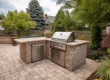
How the patio will be used shapes the choice, too. Furniture, a fire feature or a grill each add weight and wear in particular spots. If you’re planning to cook outdoors, our guide to planning an outdoor kitchen in Northeast Ohio covers how the patio beneath an island has to be built. Curves, steps and level changes can be built with either material, using cut units for pavers and shaped forms for concrete, and either way the plan has to send water off the patio and away from the house.

How Do You Choose Between Pavers and Concrete for Your Patio?
Start with how you’ll use the patio, the look you want, how you feel about joints compared with the chance of a crack and the site the patio will sit on. Pavers fit when you want pattern and color, when you expect to open the surface for repairs or additions and when you’d rather reset a settled spot than seal a crack. Concrete fits when you want a continuous, clean surface with fewer joints and a simple shape, and stamping and color can give it a decorative finish. Either material depends on a well-prepared base and on water moving off the patio and away from it. Cost depends on the size, the site and the design, so it’s best settled with an estimate for your yard rather than a rule of thumb.
A new patio can be one part of a bigger change. The beds that edge it may have grown past their space, or the plantings around an old patio may need rethinking along with it. If so, our guide to overgrown shrubs and when to prune, replace or redesign can help sort out the plants before the new surface goes in. Planning both together keeps the patio and the beds around it in scale.
Before talking with a contractor, it helps to know how you’ll use the space, how many people it should hold, which walkways or walls it should match and where water collects on your property. Photos of patios you like help, too. When you’re ready to compare pavers and concrete for your own yard, contact Hemlock Landscapes to start the conversation.